MAXX MATH LEARNING
MATHEMATICS – MODEL QUESTION PAPER
CLASS VIII
STD: VIII
Date: ____________
Time: 2 hours
Reading Time: 10 minutes
Marks: 80
GENERAL INSTRUCTIONS:
Read all the questions carefully.
Write the answers neatly and clearly.
Diagrams are not to scale, unless otherwise mentioned.
Show all necessary working.
SECTION A – OBJECTIVE QUESTIONS (6 × 1 = 6)
Choose the correct option.
Which of the following rational numbers lies between −5/6 and −1/2?
(A) 3/4
(B) 2/3
(C) −7/10
(D) −3/5
Solve: 2(3x − 1) + 4 = 20.
(A) 2
(B) 3
(C) 4
(D) 5
Which of the following is a perfect square?
(A) 950
(B) 1024
(C) 1080
(D) 1156
The cube root of −4913 is
(A) −15
(B) −17
(C) 17
(D) 19
A polygon has 9 sides. The sum of its interior angles is
(A) 1080°
(B) 1260°
(C) 1440°
(D) 1620°
In the given figure, find the value of x is


(A) 20
(B) 34
(C) 30
(D) 36
SECTION B – FILL IN THE BLANKS (7 × 1 = 7)
Fill in the blanks with the correct answer.
The sum of the first 15 odd numbers is __________.
√1764 = __________.
The additive inverse of −11/18 is __________.
A three-digit number has 4 as its hundreds digit and 7 as its tens digit. If the number is divisible by 9, its units digit is ______.
The area of a trapezium is 144 cm². If its parallel sides are 16 cm and 20 cm, then its height is __________ cm.
A square and an equilateral triangle have the same perimeter. If the side of the triangle is 14 cm, the side of the square is __________ cm.
In the given data: 6, 9, 12, 6, 15, 9, 6, 18, 12, 6, 9, 21, 6, 12, 9, 6, the frequency of the number 6 is __________.
SECTION C – ASSERTION AND REASONING (2 × 1 = 2)
Choose the correct option.
Assertion (A): The diagonals of a rectangle are equal.
Reason (R): Opposite sides of a rectangle are equal.
(A) Both (A) and (R) are true and (R) is the correct explanation of (A).
(B) Both (A) and (R) are true, but (R) is not the correct explanation of (A).
(C) (A) is true but (R) is false.
(D) (A) is false but (R) is true.
Assertion (A): Every non-zero rational number has a multiplicative inverse.
Reason (R): Zero has no multiplicative inverse.
(A) Both (A) and (R) are true and (R) is the correct explanation of (A).
(B) Both (A) and (R) are true, but (R) is not the correct explanation of (A).
(C) (A) is true but (R) is false.
(D) (A) is false but (R) is true.
SECTION D – SHORT ANSWER QUESTIONS (10 × 3 = 30)
Answer the following. Show necessary working.
Simplify:
(7/8 + 5/12) − (3/4 − 7/18)
Solve:
5(x − 4) − 3(2x + 1) = 7.
Find the smallest perfect square number which is greater than 5000. Also find the difference between the two numbers.
In a rectangle ABCD, diagonals AC and BD intersect at O. If ∠AOB = 64°, find ∠BOC.

Evaluate:

∛(6859 − 4913)
The decimal part of π up to 15 decimal places is 3.141592653589793.
Find the frequency of the digits:
(a) 1
(b) 5
(c) 9
In a parallelogram, one angle is 110°. Find the measures of the other three angles.
The perimeter of a rectangle is 84 cm. Its length is 5 cm more than twice its breadth. Find the length and breadth.
The following table shows the marks obtained by 40 students in a test.

The area of a rhombus is 96 cm². If one of its diagonals is 12 cm, find the other diagonal.
SECTION E – LONG ANSWER QUESTIONS (5 × 4 = 20)
Answer the following. Show necessary working.
Prove that the diagonals of a rectangle bisect each other.
Find the least number that must be subtracted from 5000 to make it a perfect square.
Construct a quadrilateral MORE with MO = 6 cm, OR = 5 cm, RE = 7 cm, EM = 4.5 cm and diagonal MR = 8 cm. Write the steps of construction and draw the figure.
A purse contains ₹5, ₹2 and ₹1 coins in the ratio 2 : 3 : 5. If the total value of all the coins is ₹210, find the number of each type of coin.
The following double bar graph shows the number of students in two sections of Class VIII who participated in different activities. Study the graph and answer the questions.

(i) Which activity has the highest total number of students?
(ii) In which activity is the difference between the two sections the greatest?
(iii) Find the total number of students in Section A.
(iv) How many more students are there in Section B than in Section A?
SECTION F – DATA HANDLING / APPLICATION (3 × 5 = 15)
A school recorded the number of saplings planted each day in a week.

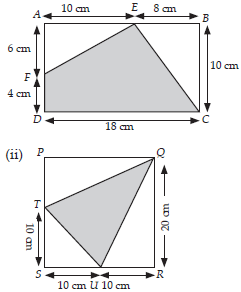
A field (not to scale) is in the shape shown, made up of a rectangle, a triangle and a semicircle.

Find the total area of the field.
Solve the following equations:
(a) 7x − 9 = 4(2x + 3)
(b) (3x + 5)/4 = 2x − 1
ALL THE BEST!